


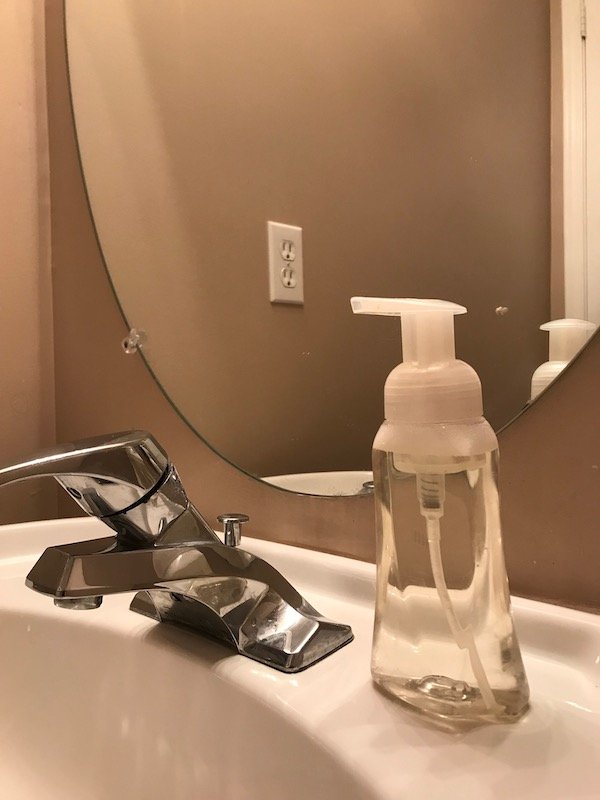
See how quick and easy it is to whip up a batch of homemade foaming hand soap with just 2 simple, natural ingredients!
Remember when you’d walk into the store, and there was just a small handful of options for each product?
Big or small. Long or short. White or wheat.
If you needed soap, it all boiled down to the green bar or the blue bar. That was it. But nowadays, we have so many options, it can get a bit overwhelming!
Bar soap. Liquid soap. Face soap. Bath soap. Soaps for babies and soaps for pets. So. Much. Soap.
And now we have a new kid on the block: foaming soap.
I’ve always been intrigued by this seemingly magical soap that looks like a clear liquid, but then comes out of the pump in massive, white billowy bubbles. How the heck do they do that?!
But most of the foaming soaps on the market contain harmful chemicals like harsh detergents, artificial fragrances and preservatives, so I had a hard time finding a non-toxic foaming hand soap that I could buy.
Did you know that artificial fragrances are now known as “the new secondhand smoke“? (read more)
When I started doing a little research on foaming hand soap, I learned something pretty crazy.
Those little foaming soap dispensers you see at the store? They’re filled with mostly water and just a little bit of soap. It’s actually the dispenser that does all the work. So these companies are charging full price for a dispenser of soap that’s about 80% water!
Well, you know what that means, right?
I just had to try my hand at a homemade foaming hand soap recipe. And you know what? This is seriously the easiest homemade anything you’ll ever make – promise! It’s even easier than my other favourite simple recipe for non-toxic deodorant.
Homemade Foaming Hand Soap Recipe
The ingredients are pretty simple:
- Distilled water or purified water – you can find this at most grocery stores. Otherwise, water that you’ve boiled and cooled is fine.
- Castile soap – I like using Dr. Bronner’s in lavender or citrus. You can also use regular hand soap, but if it’s a thicker soap, it might need to be diluted a bit more (not sure).
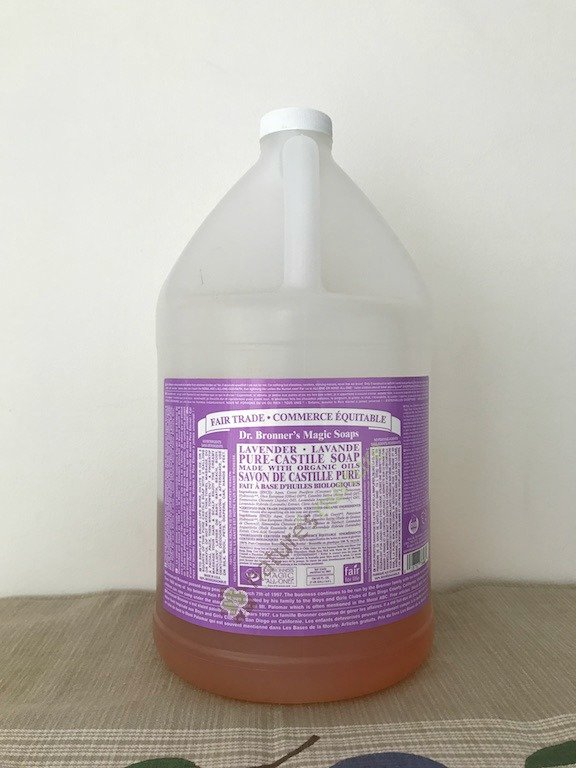
That’s the bare minimum that you need to make this non-toxic foaming hand soap – just two ingredients.
You’ll also need a foaming soap dispenser bottle. If you have old ones, you can just wash those out and use them. Or you can order a set of 4 bottles for a fairly good price from this link.
Now if you want to add your own scents, make an anti-bacterial version, or need a little more moisturizing action, here’s what you can add:
- Essential oils – I get my oils from NOW or Plant Therapy. Lavender, peppermint, and the citrus oils have give a nice scent and can be very refreshing. Tea tree oil has strong anti-bacterial properties. Add anywhere from 5-7 drops of essential oils.
- Sweet almond oil or Vitamin E oil are moisturizing – if you have vitamin E capsules, you can just break open a couple of those and add that in, or you can use almond oil or fractionated coconut oil.
NOTE: Since oil and water don’t mix, you’ll probably have to shake the bottle from time to time just to get everything incorporated again.
So here’s what you do:
Fill up the foaming pump bottle about 4/5 of the way up with distilled or purified water. Then fill it almost to the top with the castile soap.
Always add the water first, and then the soap. If you add the soap first, then when you start filling it with water you’ll just make lots of bubbles and throw everything off. Remember to add the water first.
Make sure to leave some space at the top for the pump to fit inside, otherwise it will overflow. Trust me.
This is a very forgiving recipe, so you can just eyeball the amounts. But if you’re really looking for an exact recipe, it’s about 3/4 cup water and 2 tablespoons of soap.
Lastly, you can add your essential oils and moisturizing oils for a special touch.
I don’t even bother with the essential oils or the moisturizing oils anymore. I just use the lavender or citrus castile soap, which gives enough scent for me.
And I’m used to moisturizing after I wash my hands anyways because of my eczema prone hands.
Once you’ve added everything, give it a good shake to combine the soap and oils with the water and that’s it – you’re good to go!

Test out your pump and you should have a nice, thick, homemade foaming hand soap for a fraction of the price of the store bought version – and without the harmful chemicals!
Homemade Foaming Hand Soap
Equipment
Ingredients
- ¾ cup distilled water distilled is best to prevent impurities, but boiled and cooled would be ok
- 2 tablespoon liquid castile soap or your favourite natural liquid soap; thinner is better
- 5-8 drops essential oil optional; not necessary if using a scented soap
- ½ teaspoon moisturizing oil optional; vitamin E, almond oil, or fractionated coconut oil
Instructions
- Fill your soap dispenser with water.
- Add castile soap to fill the rest of the bottle, leaving some room at the top for the pump to fit.
- Add essential oils and moisturizing oil, if using.
- Cover dispenser with pump and shake to combine the oils and soap with the water.
Notes



Hi! I wanted to use a 10oz foaming soap dispenser… Would you be able to send me the exact amount of all Ingredients for it:-))
I really appreciate it!!
They really don’t have to be exact, but for a 10oz bottle I would probably do a little less than 1 cup of water and 3 tablespoons of soap. Always make sure to leave a bit of space at the top so the pump can fit inside without the liquid spilling over.
So easy and works perfectly! Wish I’d had the lavender but tea tree will work for now. I added a touch of sweet almond oil to help with my dry winter hands.
Glad you love it, Sandi!
Thank you very much for giving this information. I’m interested to made foaming hand soap.
How long will the foaming soap last? I am concerned about bacteria and have read anywhere from a week to a month, regardless of what water you use. I’ve read about natural additives like Germall Plus, any thoughts about that?
Honestly, I’ve never had a bottle last more than a month, and it’s never gone bad during that time from what I can tell. I always use distilled water though. When I used to use tap water, I would notice “stuff” floating around in the bottom of the bottle after a couple of weeks. It was more like a film though, and I think it’s the castile soap reacting to minerals in the tap water. Still never noticed anything off like a smell or anything like that.
I applaud and appreciate your efforts . I wonder if we can avoid buying plastic bottles and containers for making these home products. That would be a double win.
That surely would! Baby steps… 🙂
Thank you Sarah! I’ve been making my own foaming hand soap just using liquid hand soaps like the Lavender-Chamomile from Trader Joe’s, but I wasn’t getting consistent results – sometimes too thick to pump, sometimes too thin & not making enough bubbles. Most recipes, just have you eyeball it, which is fine, usually, but I wanted to get better results, & I just got a new bottle of Doc Bronner’s Peppermint… yum! It never occurred to me to put the H2O in first – LOL! Can’t wait to explore more of your blog. Happy New Year!!
That’s great, Mel! So glad it’s working for you. 🙂
When you say 4 parts do the mean cups?
Not necessarily. When I say parts, I mean whatever measurement you’re using. So for this recipe’s example, 4 parts water : 1 part soap, if you’re using cups, then you’d use 4 cups : 1 cup. But if you’re using tablespoons, it would be 4 tablespoons water : 1 tablespoon soap. Does that make sense? Basically it’s 80% water : 20% soap.
Love this! Thank you. You really have some great ideas and help me get my creative juices flowing!
Thank you
Awesome, Teresa – you’re very welcome!
Thanks so much you have the right ideal. Making my own hand soap is what been wanting to do just didn’t know how, got it now and thanks again.
You’re welcome, Don. Enjoy!
Hello. I have been making my own foaming soap with filtered water and Dr. Bronner’s liquid castile soap for years. Lately, I’ve noticed a white film that settles on the bottom of my pump dispenser. I have noticed this after about a week or 2 after mixing up a new batch. I am concerned it could be bacteria. I have thoroughly cleaned all my soap dispensers and even replaced them. This white film never appears in the bottle of full strength Dr. Bronner’s soap and I do not add additional essential oils. Does anyone know what this is?
Hey Cathy, I’ve experienced that in the past as well. Are you using tap water or distilled water? I found this problem decreased dramatically once I switched to using distilled water in my cleaners. I think it has something to do with the minerals in tap water interacting with the soap maybe?
thanks for the reply. The water I use goes through a home water softener and reverse osmosis system.
A reverse osmosis system removes contaminants such as dissolved salts, Lead, Mercury, Calcium, Iron, Asbestos and Cysts, so I do not believe this film is due to minerals. I will purchase a gallon of distilled water and do a side by side comparison with my house water. I will report back the results in case anyone else is having similar issues 🙂
Hmm, interesting…Yes, please do share the results of your comparison, as I’m very interested!
This is so useful! I am never content with the quality of any hand soap that I use but never tried home making it. That’s because I always thought it would be harder than this. I’ll definitely try the one with lavender essential oil since it smells absolutely great. Thank you, will try and get back to you with the result! 🙂
It really is super easy as long as you have the right tools. 🙂 Good luck!
If you make foam soap from bar soap what ratio should you use?
I really don’t know, Han-Lin. If you’ve made the soap into liquid, you could start out with the same ratio I give here, and then adjust from there. Best of luck!
Isn’t it crazy how much they charge for those foaming soaps? I’ve been doing this for a few years now too. I like to use lemon and lavender together…they smell divine! Thanks for all the good info on your blog!
Lemon and lavender sounds like a lovely combo! And yes, totally crazy how much those soaps cost lol.
What if you don’t want the foaming action, just regular soap? I’m currently using Dr. Bronner’s Tea Tree in my bathroom and kitchen sink. That’s still good, right?
Yes, of course! We just like the foaming pump because we can stretch it for longer, plus the Bronner’s on its own is super watery. But straight Bronner’s is totally fine! 🙂
I’ve been refilling foaming soap dispensers for about 15 years now. I broke down and bought one for about $15 because the last two went kaput for some reason. I usually use cheap dish soap that has a smell I like, such as grapefruit by Ajax. I know it’s not non-toxic but that’s me. Maybe when the dish soap is done, I’ll try the Bronner’s.
Btw, I love your recipe for the all purpose cleaner and make a gallon at a time and refill my sister-in-law’s spray bottle for her. I usually use vinegar and water for most things-mirrors, dusting, etc., but your all purpose cleaner when I’ve let something go or mega sticky stuff. Thank you so much.
Woah, 15 years?! Awesome! And yay for gallons of all-purpose cleaner! So glad to hear it’s working well for you (and your sister-in-law).
There is a GREAT foaming hand pump at Amazon that actually had the lines for measuring the correct ratios for foaming soap. the design hides these lines and it is beautiful. I bought two for me and several as gifts with the homemade soap inside. The link follows:
https://www.amazon.com/Better-Living-Products-Dispenser-White/dp/B00DPMEJ98/ref=sr_1_14?ie=UTF8&qid=1486607290&sr=8-14&keywords=foaming+soap+dispenser
That looks beautiful, Carol! Thanks for sharing that!
I’ve been making my own foaming soap for awhile, too — love it! I’ve tried olive oil, but am not thrilled with it, so I might try some E or almond oil as you suggest. Glad you’re sharing this recipe — should save people a lot of money (and plastic) on soap!
Yeah, I wasn’t too thrilled with olive oil either. And these days it’s just water and soap because I can’t be bothered with anything else right now, lol.
I make my own foaming soap with Dr. Bronner’s and I haven’t added oils to it though that sounds like like a great idea. One thing that I have noticed doing this for a couple of years is that the pump gets clogged up and starts sticking after awhile, pushing down but not rising back up. Eventually it would just stop working altogether. I noticed that one of the pump bottles had castille with glycerin in it as its original soap. Once I started adding a little bit of glycerin to my soap recipe this was no longer a problem. I wonder if the oil would do the same thing?
Hmm, that’s interesting, Eden. I’ve been using mine for years, and it’s never once clogged up. Guessing some pumps work better than others. But the glycerin tip makes total sense! Thanks for sharing. 🙂
Thanks. Going to give this a try. Go through so much soap in Program, and it would be great to use something the kids can help to make, and also that isn’t adding harmful chemicals to our water supply. Now, off to find where I can get some Castille soap.
Awesome, Annelise! You can find the castile soap on Amazon (at the link I included) or at your local health food store (like Whole Foods, etc.). Let me know if you need help, and we can track it down for you locally!
I just read your article it was just amazing and best home remedy .Thank you
You’re very welcome, John 🙂
I used a little olive oil, but it now separates all the time. Anyone else have this issue? What can I do to alleviate this? Thanks in advance!
Even without the oil (which I’ve stopped adding), mine usually separates as well because the castile soap has oils in it too. So I just give it a good shake every once in a while. 🙂
Thank you! I am so grateful for finding your blog.
Oh, ShaLonda, you’re very welcome! Enjoy, and you can always email me with any questions. 🙂
Hi, could you please let me know why filtered water is required and would other types of water work as well (tap, distilled, purified, etc.)? Thank you!
You can use either distilled, purified, or filtered water. Of course, distilled water is the best since it is clean of any impurities. 🙂
I’ve been using Dr Bronner’s baby soap for a while to make this sort of thing but it has been VERY drying to my hands and it leaves my sink with a white film. I added my own flower infused oil after reading your recipe but the oil separates and my husband and kids won’t shake it each time to mix. Honestly even mixing it did not help…my hands still feel tight and dry after the wash. Would a splash of witch hazel act as an emulsifier (is that the right word???) or will I end up with a chemical nightmare?
Hey Marci, does this happen at anytime during the year? I find that my hands (and skin, in general) are much drier during the winter, especially with our hard water. So I keep a bottle of lotion on my bathroom sink to remind myself to moisturize afterwards. I’m not sure about adding witch hazel to the soap; I’ve used it as an emulsifier to help essential oils bind to the distilled water in my homemade air freshener, etc., but I’m really not sure how it would react to the soap. I would probably try it, but just keep in mind that most witch hazel contains a high amount of alcohol, which can also be drying to the skin.
And my sink also gets that white film as well – I think it’s just from the oils in the soap; they don’t wash off very easily. So I just have to remember to scrub the sink down about once a week, and that usually keeps it nice and clean.
i’ve been making this foaming hand soap for the last year, and i’ve noticed that after awhile, it starts to have a funky smell. i’ve been using 1/2 teaspoon of almond oil in it. any ideas of what i can do to keep it from going bad? i think i even tried using both almond oil and vitamin e oil too.
I’ve never had that happen, Paula! Are you using distilled water? If not, it sounds like that may be the issue.
I didn’t put any essential oils but I added dove cucumber lotion instead.
Be careful with tea tree oil around cats! It’s toxic to them!! So you probably shouldn’t use it if you have a cat or will be around cats.
http://www.petmd.com/blogs/thedailyvet/ken-tudor/2014/january/tea-tree-oil-safe-pets-31282
Hi Sarah,
I tried this recipe for hand soap. It works beautifully. Smells beautiful too. A little aromatherapy while I wash. My husband even gave me–“I like the new soap.” I consider that a dual compliment, one for me, one for you! Do you have any recommendations for essential oil combinations that are antibacterial and are a little more masculine-for hubby? Pardon my asking, please. The lavender and tea tree is beautiful…
Hey Melissa,
I’m glad you liked the hand soap, and yay for compliments from hubby – those are always nice! 😉
For more masculine scents, any of the earthy or citrus oils usually work well. Things like patchouli, bergamot, cinnamon, sage, or any citrus scents. Then just a little tea tree oil for the antibacterial part. For my husband’s deodorant, I usually make his with sage, tea tree, and just a drop of vanilla to round it off, and he loves it.
Hope that helps! 🙂
I am excited to try this!! Quick question on scents… I want to try making a citrus cilantro version, but worried the tee tree might throw off the scent. Any thoughts/recommendations?
I would love to have your recipes for his & hers deodorants. Haven’t found one I really like yet. Thanks!!
My recipe is very basic. It doesn’t require an cooking at all, just mix and pour (because I’m lazy like that, lol). That being said, it works wonderfully! You can find it here: https://naturesnurture.co/non-toxic-deodorant/
I make my soap with just water and Dr. B’s Lavender soap. I do like the idea of adding oil for moisturizing. I will do that for the winter months. I bought my foaming soap bottles on ebay.
I’m ashamed to admit it (but you might be proud!), I saw someone in my building throwing away an empty Dial foaming soap pump and I fished it out of the recycling bin (it was right on top!). I came home, rinsed it off, and filled it 4/5 with water and 1/5 with Dr. Bonner Peppermint soap. I didn’t add any additional essential oil because I figured the peppermint oil would be enough. It works great at the kitchen sink – the peppermint oil is great at getting tough smells like garlic off my hands!
Haha, you’re right I AM proud! And I use the peppermint soap at the kitchen sink as well 🙂
Thank you! I was just looking to find what others have found works best against tough odors on skin. Peppermint sounds great.
I cook with onions and garlic nearly everyday and use Dr. Bronners Lavender soap and water in an old foaming soap dispenser and it always takes away the strong odors on my hands.
I only use the lavender now too! Such a nice scent, and you’re right – it works great for kitchen odors.
Just made this with the Peppermint soap… YUM~!!!!
Just found your blog today. So many things I want to try!! This one especially since my son is learning to wash his hand and he loves foamy soap (of course). And I love Dr. Bronner’s too. I’m making this one asap!
Curious if anyone has tried any other combination of essential oils?
Orange is also a good oil to use in soaps, especially for the kitchen and bath! Just play around with whatever scents you like – I used tea tree for its antibacterial properties, and lavender because I love the scent.
Thanks. The kids love foaming soap, but I would prefer to have something all natural. This recipe is perfect, especially since my preschooler happens to love the scent of lavender.
Any ideas on a natural colorant? The water and soap look a little dingy in the clear dial pump! 👀
Hmm, no I don’t have experience with natural colorant. Are you using tap water? That could probably be why. I use distilled water because it lasts so much longer and stays completely clear and see through the whole time.
I always use a 9:1 ratio of water to soap. Can you believe the price of foamy soap, when it’s 90 percent water!? Anyway……
I haven’t ever tried foaming soap before, but it sounds like something my kids would enjoy having. I never really understood how they made the soap foam, but being mostly water and a little concentrated soap makes sense!