


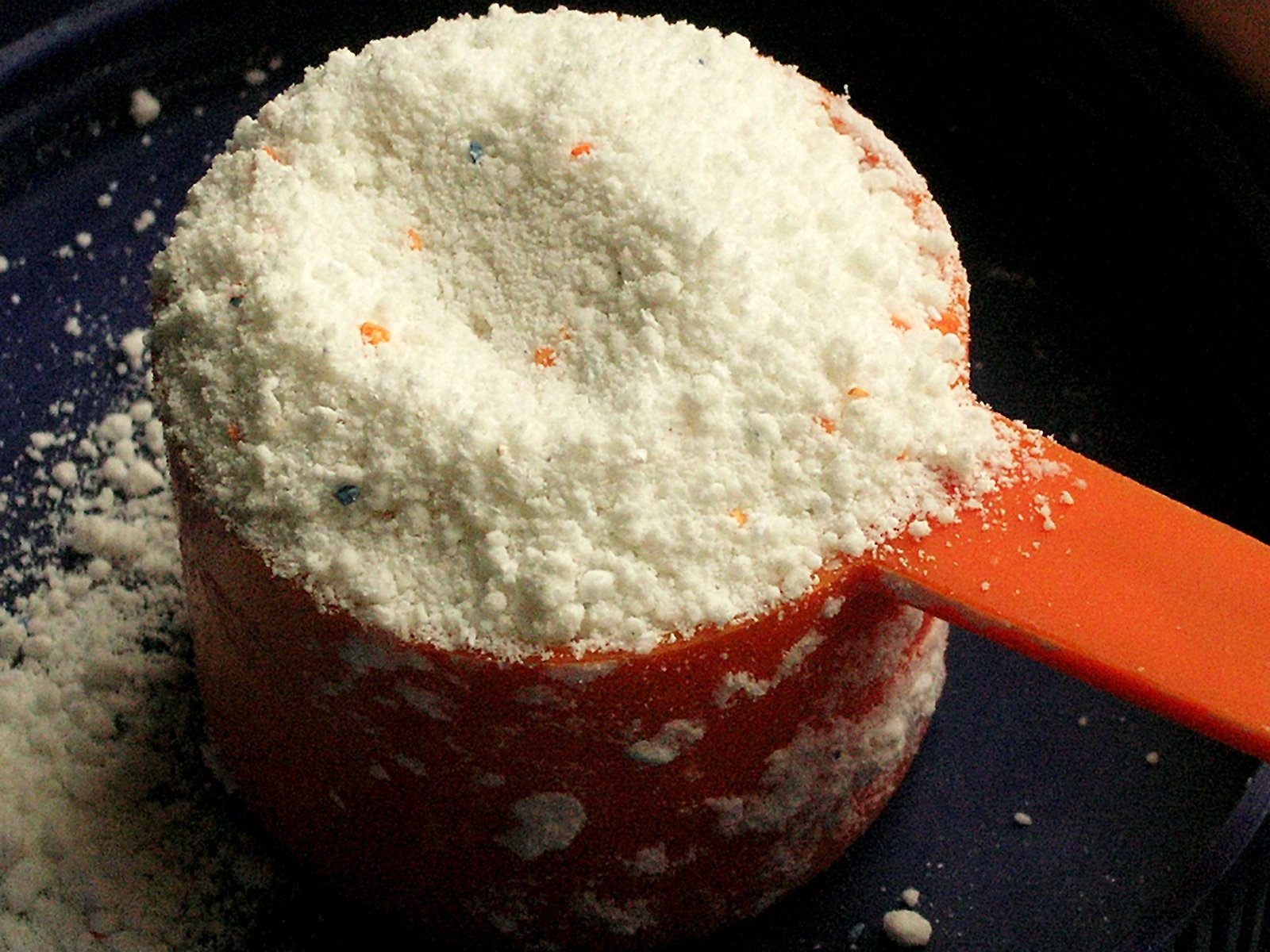
There’s a big problem with your homemade laundry soap, and you’re not going to like it. Read this before doing your next load of laundry!
NOTE: Just a little forewarning that this is a pretty long post – one of my longest, actually. It’s jam-packed with information about this homemade laundry soap issue, so grab a cup of your favourite beverage, get comfortable, and join me for this in-depth discussion…
Also – please note: This is just my experience with this issue. I know many people who are still using – and loving! – their homemade laundry soap, which is awesome. But this post is meant to share my personal experience, in case it’s helpful for anyone who has had similar issues.
One last thing – several readers have mentioned that the liquid version is better than the powder version because it doesn’t cause build up. Or even dissolving the powder version in some boiling water first before adding it to your washer. These are great tips that are worth checking out.
Ok, on to the post!
I still remember being pregnant with my first baby. I was over the moon excited!
But after the initial shock and thrill calmed down,
things got real.
I realized right at that moment that everything I put in, on, or near my body would affect this precious new baby growing inside of me. Every bite of food, every bath product, every cleaning product…
All of a sudden, my whole house seemed like a toxic no-go zone. Nothing felt safe. Everything was going to kill me. And I couldn’t touch, let alone breathe in, any of the chemicals that were now taking over my house!
Yes, I know I was being a little over-dramatic, but I’ll just blame that on the pregnancy hormones. 😉
Either way, I knew one thing, and I knew it well – when the time came to wash the baby’s new clothes, I was NOT using the same conventional laundry detergent (cough – Tide® – cough) I’d been using since well…pretty much as long as I can remember.
And by that time I was on a small DIY-kick with my homemade non-toxic deodorant, so I was already feeling up to the challenge of making homemade laundry soap. I mean, how hard could it really be?
Turns out, not that hard at all.
Just a few simple ingredients, stir them all up, and you’re on your way to the cheapest, non-toxic homemade laundry soap you’ll ever find.
I washed a few loads to test it out, and it seemed to get the job done. And it really was cheap – I’m talking pennies per load. That’s a huge win in my book!
I later replaced all my other laundry products with a few simple alternatives to help naturally freshen my laundry.
But ever since that day, there’s been a big problem brewing in the background.
Something I’d never considered before. Something so small I didn’t even notice it…at first. Until that small thing started getting bigger, and bigger, and bigger. Until one day I woke up and realized, you know what?
This laundry doesn’t feel right.
Something is wrong here. Something is off. There’s an odd smell coming from the linens. These shirts don’t feel as soft as they used to. And why on Earth is this bath towel not absorbing water like a normal towel?!?
But even after all that? I still pushed these thoughts and feelings to the back of my mind. I convinced myself that the laundry was indeed getting cleaned. I mean look, I put this muddy shirt in the machine, and 20 minutes later it came out clean, see?
Except, it wasn’t clean.
Far from it.
Sure, the mud got rinsed away in the water and it now looked cleaner, but something else was left behind. Something pretty gross, when you really think about it. And after some digging, I finally figured out what it is.
Buildup.
Yep, buildup. Of minerals from hard water. Of the soap flakes in my homemade soap. Of dirt, and grime, and pretty much any particles that ever came in contact with our laundry.
It was all still there.
Building up. Slowly. Over time.
And here I am, five years later, putting it all together for the very first time.
It all started when I read a post from ButterBeliever.com telling me why I needed to stop using my homemade laundry soap.
I must admit, when I first read it I was feeling completely defensive. Like, pshhh my homemade laundry soap is awesome, and there’s nothing you can say to convince me otherwise…
But I was in denial.
Because that post planted a little seed in my mind, which slowly grew and grew, until it became too big to ignore. And when a friend of mine emailed me to ask for my opinion on this same exact issue?
That was it.
I was determined to research the heck out of this buildup issue and get to the bottom of it once and for all.
What is laundry buildup?
Laundry buildup happens when any type of matter becomes lodged in the fibers of your laundry because they aren’t being properly washed/rinsed away. It’s the minerals from your hard water, like magnesium or calcium. It’s the soap flakes in your laundry soap/detergent (homemade or store bought). It’s also dirt, dust, grime, and bacteria. Ewww.
What causes this buildup in laundry?
A few main issues are usually at play here. If you have moderately hard water (most of us do), then the mineral deposits in your water can slowly buildup in the fabrics of your laundry.
And if you’re washing with a good, strong detergent and adding a water softener (like borax or washing soda) that’ll usually do a good job of keeping the buildup issue in check.
But when the buildup is from the soap flakes you used in that homemade laundry soap recipe? Well, then there’s a bigger problem.
What’s the difference between soap and detergent?
The problem comes when we start using the terms ‘soap‘ and ‘detergent‘ interchangeably, when in fact they are not the same thing! I’ve always wondered what the difference is between these two terms, and I finally have a clear, concise explanation.
Bear with me – we’re about to get a tiny bit technical here…
Both soaps and detergents are a kind of surfactant – a compound which breaks the surface tension between a liquid (water) and a solid (dirt). These guys are actually pretty cool, because on one end they attract water (hydrophilic), and on the other end they push away from water and attract dirt and oil, etc. (hydrophobic).
So in your washing machine, surfactants get to work by attaching themselves to the dirt, oils, and other particles on your laundry, as the washer agitates to help loosen them up out of the fabrics and into the water, where they stay suspended until the rinse and final spin cycle flushes them out without the dirt getting redeposited back onto your now clean laundry. Fascinating, isn’t it?
But there’s a major difference between soap and detergent:
- Soaps are made with fats or oils. They’re great for cleaning hard surfaces that don’t have tiny holes and crevices, because they’re scrubbed hard, then rinsed away easily without getting trapped in any fibers. Soaps are not great for soft, porous surfaces because they’re oil-based, they can embed themselves within fibers, and they don’t rinse away easily (hello, soap scum!).
- Detergents are either synthetic or plant-based. They’re better at cleaning laundry in a machine because they’re more soluble, especially in hard water, meaning they won’t bind themselves to the minerals in your water and buildup in the fibers of your laundry. They also rinse away easily, leaving no residue behind on your laundry.
What’s wrong with the homemade laundry soap?
Simple. If we look at the recipe I have here at Nature’s Nurture, you’ll see it uses 4 main ingredients: soap flakes, washing soda, borax, and baking soda.
The washing soda and borax are great water softeners, and either one should be regularly added to your laundry routine, especially if you have hard water. The baking soda is for deodorizing and brightening your fabrics.
But what about the soap flakes?
This is supposed to be the cleaning agent in this recipe. Only problem is we’re not using it to clean a non-porous surface like our hands, or the kitchen counter, or that one wall in the house that the kids have declared their personal Picasso wall.
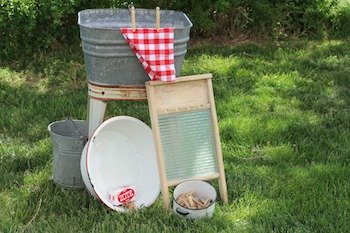
No, we’re trying to clean soft, porous fibers on our clothing, our towels, and our bedding. And soap? Soap is just not going to cut it. Not unless we have a way to scrub the living daylights out of these fabrics, like say, a 1920’s washboard, maybe?
We need something different from soap. Something that was made for cleaning laundry in a modern day washing machine.
What we need, of course, is a detergent.
And since we can’t make a detergent without an advanced degree in chemistry and a fully-equipped lab, we have to buy one.
I know what you’re thinking…
You’re thinking, “But Sarah, this homemade laundry soap is awesome, and it’s safe, and it costs pennies for each load!”
I know. Believe me, I know. Making this soap every few months was one of my favorite projects ever. But I also know that there’s a delicate balance between the products we can make at home and the ones that we’re better off just buying from the store.
For me, laundry detergent is being moved from my “make it” list to my “buy it” list.
And maybe you’re not quite there yet.
Maybe you’re using the homemade laundry soap, and your laundry is coming out so fresh and so clean. That’s great! If you have softer water (most people don’t), then you might not ever notice a problem with using soap, and I must say, I kind of envy you right now.
But if you have even the slightest feeling that maybe this homemade deal is feeling a little…off? Like it just doesn’t feel quite right? Like your laundry shouldn’t have to feel or smell or look the way it does?
You need to stop using the homemade laundry soap.
And the next step? You need to strip your laundry.
Because your laundry has accumulated a ton of buildup from the water, the soap, and then other particles like dirt and bacteria, you really should do a chemical strip of your laundry in order to remove all of those nasties before going any further. Full details and instructions are at the link below.
>> Learn how to strip your laundry here >>
The first load that I stripped was our light-colored towels and linens. Then I went on to strip a load of dark towels and linens, and then a load of just my and my husband’s whites (and greys).
Take a look at what the leftover stripping water looked like after I soaked each load in the stripping solution for about 4 hours, then wringing out the water from each item:
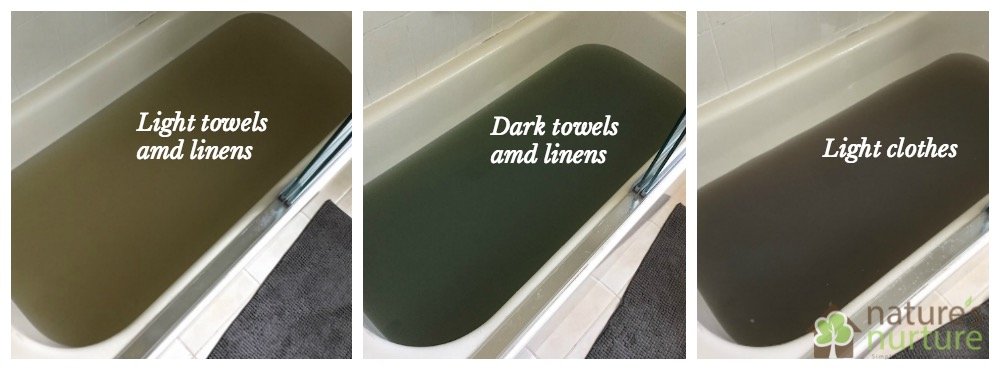
That was it for me.
This is what finally lit a fire under me and pushed me to get this information out there to you. Because I need to take responsibility for the fact that I’ve been recommending this homemade laundry soap recipe to you for years – YEARS!
What I saw in my bathtub seriously freaked me out. To say that I was horrified by this water would be an understatement!
So I’m here to help you. I’m here to save you the trouble of constantly wondering if that homemade laundry soap really is getting your clothes clean, or if that weird dinginess is just all in your head.
Did you know? Conventional laundry detergents and fabric softeners are designed to leave behind a residue on your clothes — even after they’ve been rinsed with water? They contain optical brighteners and conditioners that work by coating fabrics to give them that “whiter than white” look and “snuggly soft” feel.
So even if your laundry has been washed exclusively with conventional detergents and fabric softeners, it would most likely still benefit from a good laundry stripping every once in a while.
But don’t sweat it, because everything will be ok.
It’s simply an adjustment in your routine, and once you find the right product – the right detergent – that works for your family, you can move on and tackle the rest of your home and bath products. One small step at a time.
This is just a little bump in the road. You will get past it, you will move on, and you will have truly clean laundry once again.
What to use instead of homemade laundry soaps?
Here are some alternative options you can try:
- Switch to a safe, non-toxic laundry detergent. These detergents do not contain optical brighteners or conditioners, and are made with safer surfactants. Thankfully, there are plenty of brands making safer options to choose from. You can find a list of my recommended laundry detergent brands here.
- Try soap nuts. Some people swear by soap nuts and love using them in their laundry. Since they are berries with a natural saponin, they are not technically a soap, and seem to be a good option for some. I personally wash most of our laundry in cold water, and didn’t like the extra work involved to make them work for me.
- Use Sal Suds. For a quick and easy alternative that still feels homemade, you can just add some Sal Suds to your machine (1 Tbsp for HE, 2 Tbsp for regular) and wash like normal. Although this method is ridiculously easy, from my calculations, it’s not cheap. So unless you can score a gallon of Sal Suds at an incredible price, this option may not work for your situation.
It’s time to face reality.
If you’re using a homemade laundry soap, chances are your laundry is not getting cleaned properly.
It might look clean. It might smell clean. It might feel clean.
But deep down, within the fibers of your clothing, your towels, your linens – there’s a problem that’s slowly building up. And over time, it’s going to grow and grow until you just can’t ignore it anymore.
So whether you nip it in the bud right now, or you wait until it becomes more noticeable later, the truth is that soap is just not rinsing away completely.
But if you still insist on using homemade laundry soap…
Here are some things you can do to make it dissolve properly and rinse away more thoroughly:
Add vinegar to the rinse cycle. Vinegar works very well to remove hard water deposits like calcium and magnesium. Add 1/2 cup – 1 cup during your machine’s last rinse cycle. You can add it to the fabric softener dispenser or use one of those Downy balls which will release it at the right time. Don’t worry – once your laundry is dry, it won’t smell like vinegar.
Use hot water to wash. Hot water increases the effectiveness of soap, so theoretically, this could work to not only dissolve the soap better, but also to remove dirt better. I’m not sure this applies to the rinsing part, but maybe if you also use the vinegar in the rinse cycle, they can work together as a 1-2 punch.
Soft water is best. Obviously this one is out of your control, as you’re at the mercy of your city’s water supply, but it’s important to keep in mind. If you don’t have hard water, which is loaded with minerals, your homemade laundry soap is probably doing it’s job and you most likely won’t notice a problem.
Boost your detergent. Yes, your homemade laundry soap probably already includes borax and/or washing soda, but when you only add a few tablespoons of the mix to the wash cycle, the amount of borax/soda is negligible at that point. Try adding 1/4 – 1/2 cup of either or both to help soften your water and boost your homemade laundry soap’s effectiveness.
Strip your laundry every once in a while. Again, even if you’re not using homemade laundry soap, you should probably try this out just to see what comes out in the water – you’d be surprised! Full instructions can be found here.



I stopped using the homemade laundry stuff because of that very same reason. My clothes had a certain”stickiness” and became very gross! We did lose a few items due to the ick factor. If you want a good, safer alternative to regular detergent, Kirks liquid Castile soap does amazing things to your laundry and never builds up the crustiness. It is not a cheaper alternative, however. We pick and choose our battles. So, I am thinking of remaking the homemade laundry “soap” and adding a bottle of the Castile in place of the soap flakes and see how that works. And if that doesn’t work, I’ll just throw some Tide into the bucket, finish it off and be done for good. Anyway, thought I’d share that, in case anyone else wanted to give it a try. God bless!
I came here searching for a reason why my laundry has began to stink like a wet dog. I’ve been making my own soap for 6+ months now and thought it was wonderful. Recently— the smell! 🤢 I thought maybe I left them in the washer too long so I rewashed them to no avail. After reading this blog post, it all makes sense now. I will be stripping my laundry and finding a new nontoxic brand to buy. Thank you so much.
Thank you for this post! I’ve been using homemade laundry soap/detergent for a few months now. I have a couple of questions. I make mine with washing soda, baking soda, and young livings Washing soap, cleaner concentrate, and dish soap. I just looked at the laundry detergent that I use in my mixture and it says “laundry soap”. I had no idea until just now that I wasn’t using detergent this whole time.
Something that I have noticed is a smell to my clothes. My towels smell awful after getting wet and my clothes sometimes smells funky too. I really love making my laundry soap and I love using it. Is there anyway to get my clothes to not smell this way? Should I try adding borax? (I definitely want to strip and will do that soon).
And now I’m bummed cause I really wanted to love this laundry soap!
I forgot to add that I use vinegar in every cycle.
Hey Krystal, I know, it can be so frustrating when you thought you’d figured something out only to have to go back to the drawing board. I’m a little confused on the exact combination you’re using and where you mention the “laundry detergent that I use in my mixture”. You can reach out to me by email with some pictures and I can try to help you further.
I make the pure coconut soap myself and do not superfat it, its the superfatted soaps that leave soap scum. You wouldnt use soap that hasnt been superfatted on your body as it would be very harsh for the skin but for laundry it’s great. I also add fruit enzymes and get no residue. Also, as someone else mentioned keep the soap portion lower percentage wise as you do not need much. I would also note that homemade laundry powder is not great in cold water washes as the ingredients need heat to dissolve fully.
Thanks for that input, Hayley! Ahh so the superfat seems to be the key issue here. And you’re right, warm water is definitely needed. I’ve seen some people dissolve the soap in some hot water first before adding to the machine.
Sorry, this comment ‘grew’ slightly as my bugbear led me onto my high horse – but stick with me for some rational commentary on so-called ‘stripping solutions’ and soap-based laundry preparations.
First, let’s look at ‘stripping’ solutions: I have had a good long look at the ingredients people are using for this, and I see they always contain something that actually strips the dye from fabric, and it is this together with the long application time that causes the bulk of the ‘murk’ seen in the water. In this case, the DIY recipe calls for sodium carbonate, which is a great aid in washing as it is alkaline which aids cleaning through its highish pH and also ‘softens’ the water by reducing the rate at which soap binds to minerals in hard water causing insoluble ‘soap scum’. However, when left in contact with dyed fabrics for prolonged periods, it will leach the dye which fades your fabrics – and leaves you with murky water. (I’m not sure why you’re using sodium bicarbonate as well as sodium carbonate/washing soda… sodium carbonate is almost chemically identical to sodium bicarbonate except that it is slightly more alkaline, and therefore slightly ‘stronger’ or more effective for a laundry application – it has the same chemical properties except the latter is more chemically active, so adding both is redundant.)
The commercial preparation you refer to contains both sodium carbonate and sodium percarbonate – otherwise known as laundry bleach. Although this is much less hard on dyes than chlorine bleach, it is not without its effect. GroVia is also supposed to be used strictly in a wash cycle – it is NOT recommended to soak fabrics in it for a prolonged period – almost certainly because sodium carbonate and sodium percarbonate will leach dye and can damage fabrics with prolonged contact.
Other ‘stripping’ potions I have seen around the internets use even stronger ingredients, including ones that contain optical brighteners (of course your whites will look whiter – they’re literally fluorescing in sunlight,) and some that suggest adding washing machine cleaners, which are extremely chemically harsh, never intended for fabrics and leach out dye, damage the fibre content and react with other hocus pocus ingredients….not surprising the water takes on a funny colour!
There are pros and cons to using both soap and detergent-based cleaners. On the whole, liquid detergents are probably the best all-round clothes cleaners for washing machines, but it is very hard to find laundry detergents that are truly fragrance free and not made from petrochemicals. The ones that are are extremely expensive. Liquid detergents are also heavy to transport due to the amount of water they contain and require packaging, adding to the energy consumed per load and waste plastic we are building up. For all these reasons, I usually use a soap-based laundry cleaner – just my own homemade 0% super-fatted coconut soap and an equal quantity of sodium carbonate/washing soda, which softens the water and helps to prevent the formation of soap scum. Does it remove every stain? Of course not! (It also works best in water that is warmer than the cold washes we have got used to that have been leading to a resurgence of pests such as bed bugs.) I spot treat individual stains before washing and all in all I’m extremely happy with the results. I make sure my washing machine runs a cleaning cycle with a limescale remover on a quarterly basis, which we should all be doing anyway, so no build-up of scale, gunge or mouldy smells, and I don’t live in a hard water area, or I would certainly use a detergent instead.
So please don’t be fooled by all those silly ‘stripping’ pics lying around the internet to bait us into clicking for the satisfaction of the ‘ewwwww!’ factor: I see so much annoying misinformation about this process and so much lack of understanding from people who must surely have slept en-masse through their school chemistry lessons! Remember, being nerdy is good, being sceptical is excellent, and having a balanced and reasonable approach that is able to apply the advantages and disadvantages of any laundry preparation (or medical intervention or political stance or faith, come to that) is best of all.
😉
First of all, WOW I’d say “grew” is an understatement lol! But rational commentary is always welcome, so I appreciate the time that it took for you to get all of this out. I agree with much of what you say, and yes thanks for clarifying the whole sodium carb/bicarb issue. I have since learned just how similar (and redundant) they actually are but need to go back and update some old posts like this one. I totally see your point on the dye being pulled out of the fabrics, and I agree that a lot of the colour most probably comes from that. But I’m also going to guess that at least *some* of the colour is coming from buildup as well, just because I could literally FEEL a difference in the laundry after I’d stripped it.
I still believe homemade laundry soaps are not for everyone, and that only in certain situations would it work well (as you mentioned, hard water and using warm/hot cycle is a must). And believe me when I say that I’m incredibly happy for those who use it and love it, and find that it works for them. For me, I’ve been happily using a natural detergent for a few years now, and haven’t looked back, and this post is meant to help those who were in the same confused boat as I was.
In any case, I really do appreciate you joining the conversation and offering up your advice and experience!
Several uears ago my sister told me her DIY laundry mix was making her washer smell, but I ignored it and began making my own to save money. I used it off and on for several years seemingly with no problem, but recently after using a new batch, I began to smell a foul odor whenever starting a new load in my machine. I found some blogs that explained why my homemade laundry mix might be causing it. They also said it could be damaging my machine. I scrubbed the tub with vinegar and ran a cycle with just vinegar and hot water, then another cycle with Carbona washing machine cleaner. Then I stripped my towels, and sure enough the water quickly turned dark brown. I’m not sure I want to strip some of my more delicate clothes; I came here looking for how safe the stripping mix would be for more delicate fabrics but haven’t found that info yet. Still I hope it’s not to late to prevent damage to my machine.
I agree, I would be careful with delicates and would probably just skip them and move on to an actual detergent with the hopes that over time the detergent will sort of “strip” them anyway.
I did not strip any of my clothes/linens when I switched back I didn’t even know it was a thing lol! But my laundry quickly went back to normal after stopping the homemade stuff. Hope that helps.
If you’re having buildup on your clothes is because you’re using too much soap in your wash load and you can use 2-cycle rinses if you choose to use a lot of soap but it would save you water if you just use half the soap that you normally used to prevent a lot of usage of water and build up on your clothes I’ve been using it for years I have no problem.
I have been making and using a Borax+Washing Soda+Zote+Fels Naptha+BIZ recipe (adding an enzyme is important touch, when using soaps), in my he front loader, for going on 4 years now, and ours clothes are spotless (stripping doesn’t even get anything off them!), BUT….. We have very, very soft water… My Mom, who has hard water, hasn’t had such luck, unfortunately.
I make home made laundry soap it is Castile soap liquid or a bar I heat it up with water so it melts good then a put 1 cup washing soda and 1 cup twenty mule team borax and about 1/4 bar of Naphta stain removing bar I heat it up till it is liquified in a five gallon bucket and put about 3/4 cup per load and it works fine for me my clothes come out just fine and wash and wear just fine. not sure what home made soap she is talking about but my soap is fine!
I’m so glad you’ve found a solution that works for you, Kim!
Which laundry detergent company paid for this article?
Ha, good one! Sorry to inform you that no laundry detergent company has any idea I even wrote this. 🙂
Hi…I have been making my own liquid laundry detergent for 4 years, and have been very happy & satisfied with the results. I am very picky and cautious about everything I use. I never like powder anyway because it never mix well with water, and builds up all over my clothes. Since I have allergies, store bought irritates my skin, it stinks bad, & I break out in a rash. My homemade liquid soap has a light pleasant fresh smell. When I’m around some people or even my family, I can smell the detergent they use, and it gives me such a bad headache….just like some perfumes. How are they able to wear and smell this?…and especially put on their favorite perfume or cologne on top of that! Ugh! 🤢 .. Yes, I do use Borax in my recipe … but Thank God it doesn’t break me out in a rash. I use vinegar because where I live we have hard water. It takes me 2 days to make…to blend and mix well…and store. It is worth all my time and hard work…and my clothes are cleaner & brighter than ever before. I just put a little in the water and swish mix before I put the clothes in… because its concentrated & it goes a long way. Sometimes I think some people put to much of store bought soap to their wash. My clothes Colors are bright & stains are gone! Well, I also make my own stain remover…and named it “Stain-B-Gone!” and amazingly the stain is gone 😉. The greatest part….I don’t have to put any elbow grease into it….it does all the hard work for me. My clothes look brand new again, I don’t have allergies & break outs, and even my husband is amazed and likes my detergent. I save more money this way! 🙌🙌. I believe they don’t make things like they use to, and the stuff I use are the best of the past. I’m just a wife, mom, & crafter who’s pleased with her soap….my family & friends are too! So, to each their own….it definitely works for me. 🥰😉👍
Thanks for sharing, Janet! I love your enthusiasm, and so glad you’ve found a system that works for you! 🙂
Hi Janet, what is your Stain-B-Gone recipe? If you care to share? Thanks!
Can you please share your recipe for laundry soap?
What if I have a water softener? Would making my own laundry soap still be a bad idea??
Jennifer, I would probably try it out if I had a water softener. You could try adding vinegar in the rinse cycle if you’re still worried about buildup.
So I wash my cleaning towels with lye soap I make myself. I put them in a tub with boiling water and soap power a bit of bleach and let them set overnight then I wash them with a wash board then throw them in the washer and they come out white and soft.
My family has used homemade lye soap with great success for generations. I have read a lot of the recipes for homemade laundry detergent. And I just wanted to laugh because your barley even using anything. Not enough soap to wash the clothes not even the recommended amount of baking soda, borex, washing soda per load as it says on the box. I think the recipes are to blame and how you use the products. My mother always says that if it doesn’t work when your hand washing it won’t work in the washer.
I always melt my soap when I add it to the washer. And vinegar removes buildup by adding a decent amount to the Rinse. This one old woman I knew always told me to add the liquid lye soap until I had a decent amount of bubbles when the washer was turning and add baking soda.
Thanks for sharing, Windy! Yes, I guess “user error” definitely has a lot to do with it. 😉
What is ur receipe please
You state that our only option for using detergent rather than soap is to buy it. My understanding is that the strict definition of a “detergent” (separate from laundry-related things) is a chemical with one end that binds water and one end that binds oils, thus making them get along – i.e., literally mixing oil and water. Lecithin (from soybeans or egg yolks) is a naturally-occurring detergent by this definition, which I’ve found useful in making salad dressings and homemade ice cream. So could this also be used as a component homemade laundry “detergent”, without the buildup issues? Or would this also depend on water hardness and/or other factors? We happen to have soft water in our area so I haven’t noticed problems with my grated Fels-Naptha/Borax/Washing Soda recipe but I’d be interested to know what the chemists here think about substituting lecithin granules for the Fels-Naptha – ?
Very informative post, thank you for sharing! I am new to DIY home and body and I was wondering if anyone could recommend a DIY, clean, non-toxic liquid laundry solution?
I am so SO very glad I read this! I’m trying to convince my partner (who is set in his ways) that Low/ Zero waste green living isn’t going to be invasive and he wont notice it, and since he is in charge of doing the laundry I was about to make some washing liquid and sneak it into the old bottle without him noticing. my plan was to later inform him of the switch and encourage him to try OTHER low waste stuff.
You have just saved me a MAJOR backfire! LOL
Thanks!
LOL!
I am an advocate for using soap in many areas of our daily lives. But ‘many’ does not equates to all areas though! Great write-up on home made laundry soap and possible negating implications. I had never thought about it having been using a similar formula for a while already. Thanks for the heads up!
Hi Sarah,
Thank you for this great post!
Do you have any idea how long it’ll take for the smell of soap to be out of my clothes? Some of them seem to be holding on to soap with no plans to let it go.
Oh man, I’m not sure! Have you done the stripping process to remove the buildup?
Hi everyone. First of all, excuse my english, I’m not a native speaker😊. Please don’t use borax, it is very toxic. And for God sake avoid vinegar in the receipe , it just reverse the saponification process and leave you with fatty acids. I used to make my own cold process soap (100% palm kernel oil, not more 2% superfat, just to avoid having extra lye in my bars), and the cloths became harsh. So i’m wondering if usine a liquid soap will do the job….by liquid I mean with potassium hydroxide …has anyone tested such a formula??? Thank you for answers
A few years ago I made my own homemade soap, much like your recipe. After about six months of using it, my laundry straight up stunk and it didn’t feel clean. I ran everything through the ultra-hot “sanitizing” cycle using Tide for the detergent and that made my laundry feel squeaky clean and fresh like it hadn’t in ages. Fast forward a couple of years and I started learning to make my own lye soap and I read one tiny obsolete little article about how lye soap is horrible for your laundry and I flashed back to my own nightmare laundry fiasco. I thought, why do blogs keep touting the superiority of their homemade soap when it obviously doing more harm than good? I came across your article today and feel like, “ha, I told you so!” Seriously just use a real detergent. Honestly I only use a couple of tablespoons rather than the amounts recommended by the bottle and it still works just fine. I’ve made a blog to provide information regarding the products I made and I would like to write an article about why my soap, and soap in general, should not be used to replace your laundry detergent.
Excellent, Anna! Would love to read that article!
I’m not convinced by this article. It’s seems to be recommending the same laundry ingredients used in usual DIY laundry recipes but presenting it as somehow different.
Hmm, I’m not sure I understand. I’m not recommending you use a DIY recipe at all. I’m actually recommending that if you’re having trouble with your DIY recipe, then maybe it’s time to switch to a detergent, as opposed to a soap.
Laundry soap build up is real. And it can be removed easily by using dish liquid.
Try soaking laundry in a bucket of water with a little dish soap, then laundering in the machine without any soap added.
If you do this after every 6-8 regular loads your laundry will be clean and free from buildup
Would putting white vinegar in the final rinse (or maybe as an extra rinse cycle) solve the build up problem?
It would certainly help, but you’d have to try it for a few washes before knowing for sure.
Some assumptions are not not science based. Soap is made from oil+lye. But if made in equal amounts neither the oil or lye remains. 100% is soap. Even if you superfatted the soap, and some oil exists, it still is plant based. Fixed Oils that are used in soap are plant based, e. g. Coconut, palm, olive etc all are plant based. Essential oils like those derived from citrus actually help break up dirt and grease and are great for cleaning. Detergents are often chemical based, but manufactured Soap can be too! Mineral buildup is real but it doesn’t come from soap, it comes from hard water. Always good to question, but the goal should be to get at the facts.
Thanks for the extra insight, Greta!
I make my own liquid homemade detergent without a problem! I use a gallon container & use distilled water. I warm up 4 cups of water on my stove top add 1/2 cup of washing soda, 1/2 borax till they dissolve, add to my gallon container, then i fill it up with the rest of the water. Last i add 1/2 cup of Dr. Bronner’s Sal Suds. For non HE washer you use 1/2 cup- HE washer 1/4 cup. I also make my own laundry stain remover & homemade scent booster! I’ve been using this in my HE front load washer 2 years without no problem. This method works great for me & my family. Sal Suds is a biodegradable cleaner, It’s all i use to clean my home. Google it you will be amazed & save money just using it
Sal Suds is a great cleaner! And it’s also a detergent, which is why it works well in your homemade laundry detergent recipe. I’ll have to try out your recipe one time. Thanks for sharing!
Did you ever try Sal suds? It has SLS in it, so like Dr Bronner’s daughter said in one article on it, it creates “copious suds.” That’s not good for laundry or HE machines. I have soft water & suds from SLS never clear even w several rinses.
Haven’t used it in laundry, but I use it for cleaning around the house. It’s super concentrated, so a little definitely goes a long way!