


Quick Recipe (full recipe below!)
The best homemade dish soap uses Sal Suds as the base — not castile soap, which leaves a film on dishes. Mix it with kosher salt (for thickness), vinegar, and citric acid, and you’ll have a non-toxic dish soap that actually suds up, cuts grease, and rinses clean in about 10 minutes.
I’ve failed at more homemade dish soap recipes than I can count. They didn’t suds. They left a film. They were basically just oily water pretending to be soap.
The problem? Most DIY recipes use castile soap. But castile soap is a soap — it’s not designed for dishes, and mixing it with vinegar (which a lot of recipes call for) actually breaks down the soap back into oils. That’s why you end up with a curdled, greasy mess instead of clean dishes. (As you may notice in some of the older comments on this post.)
The fix: Sal Suds by Dr. Bronner’s. It’s a plant-based detergent (not a soap), which means it actually works for dishwashing — real suds, real grease-cutting, no film. It gets an “A” rating from the EWG.
Note: Sal Suds is for cleaning only, not hands/body. If you have sensitive or eczema-prone skin like me, use dish gloves.
Let’s make some homemade dish soap!
For this recipe, all you need is some distilled water, kosher salt, Sal Suds, vinegar, and citric acid.
The recipe is super easy too.
First, you’ll dissolve the salt in the hot water and set aside. Then you’ll combine the Sal Suds, vinegar, and citric acid in a separate container. Add the salt mixture to the Sal Suds mixture, and pour into your soap pump. That’s it!

So How Well Does It Work?
Well, this stuff works! It looks, acts, and feels like a real dish soap – it bubbles up nicely, cleans very well, and rinses away with no nasty film or residue. The kosher salt helps it thicken up a bit so it’s not as runny as some other recipes I’ve tried. But I’ve also read other’s experiences with not being able to get it to thicken, so your results may vary.

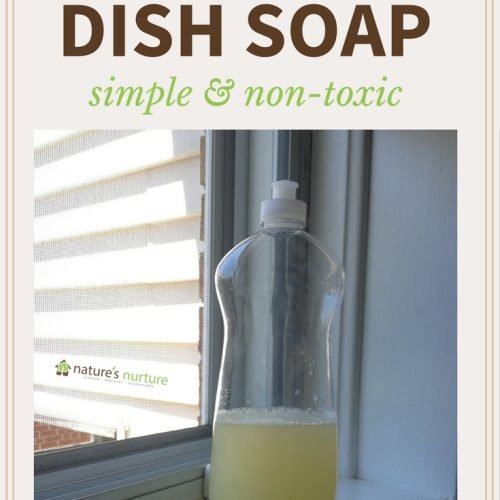
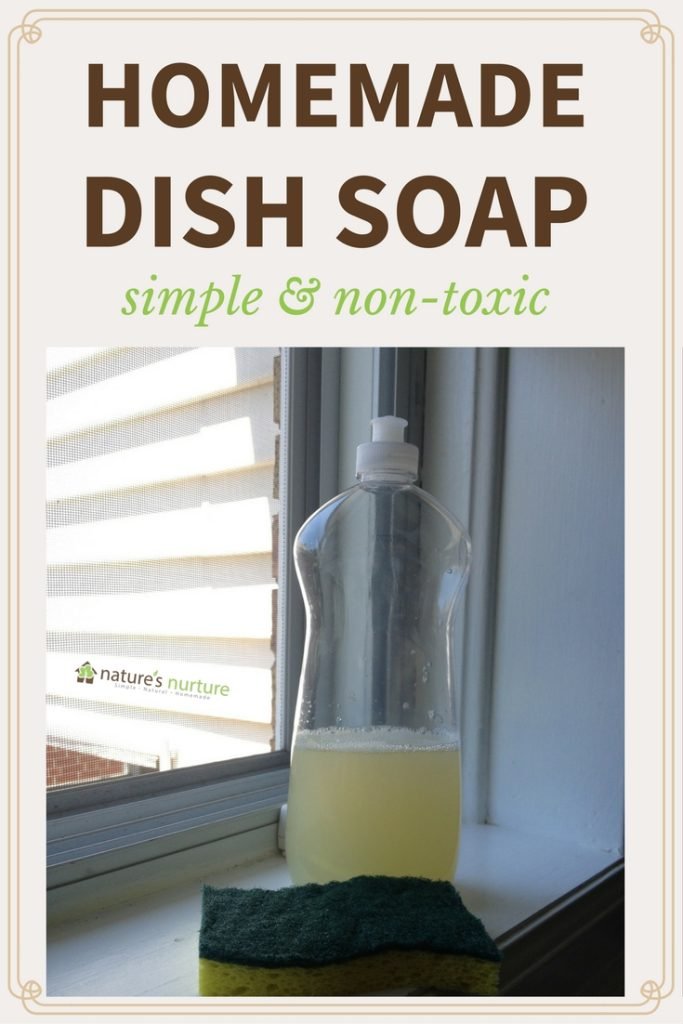
Homemade Natural Dish Soap
Equipment
Ingredients
- ½ cup distilled water
- 2 tsp kosher salt
- ½ cup Sal Suds
- ¼ cup distilled vinegar
- 1 teaspoon citric acid
Instructions
- In a small bowl, combine the hot water and kosher salt. Stir until dissolved, then set aside.
- In the squeeze bottle, add Sal Suds, vinegar, and citric acid, then swirl to combine.
- Add salt-water mixture to the squeeze bottle and gently shake until thickened.
Notes
Important Note on Dishwashing Method: I just wash my dishes with a wet sponge and soap – meaning that I don’t fill the sink with water and let the dishes soak. Instead, I squirt some soap on the wet sponge to create some suds, and wash each dish individually.
A few drops of dish soap is also what I add to my homemade floor cleaner—alongside vinegar and alcohol, it’s gentle enough for sealed wood and strong enough for tile.
How Each Ingredient Works
Homemade Dish Soap FAQs
Prefer to buy instead of DIY?
Sometimes it’s nice to skip the prep work! Here are some quality options we would use ourselves.
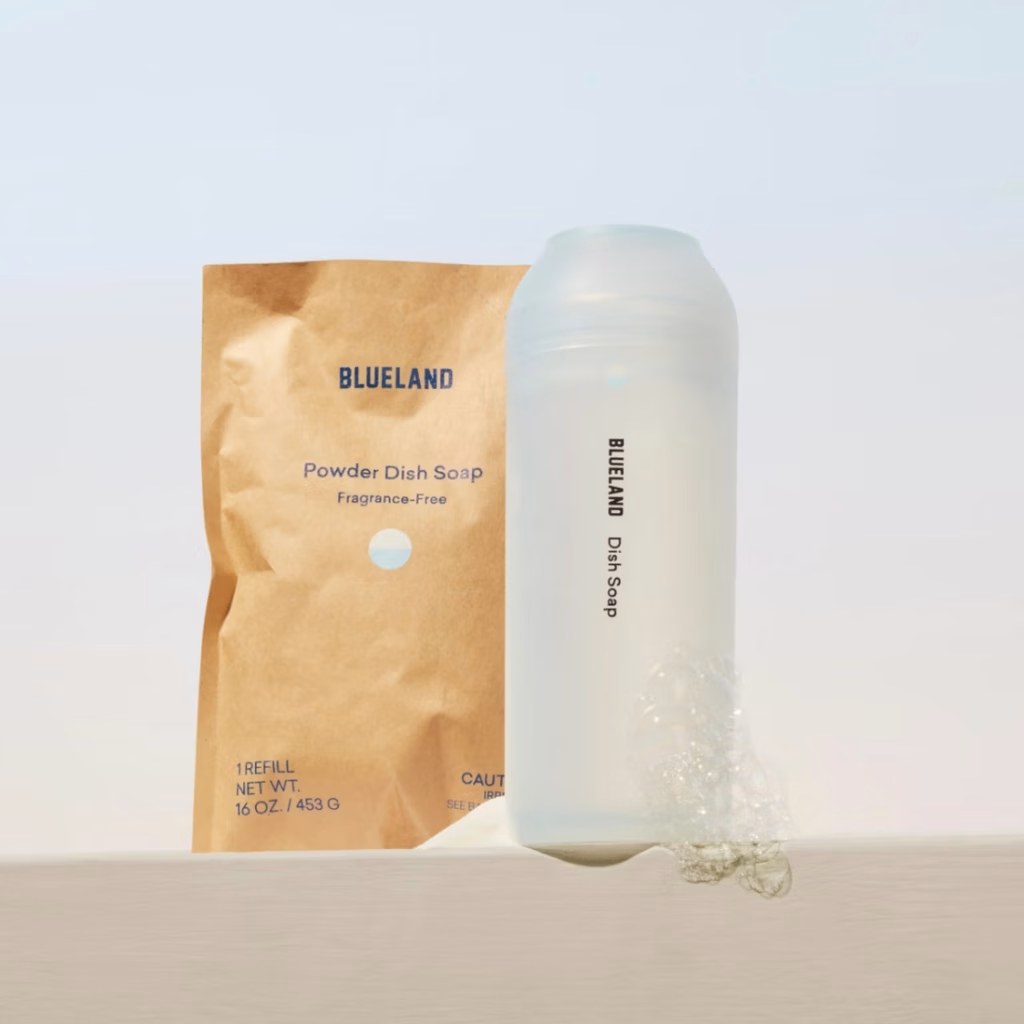
Blueland Powder Dish Soap
Blueland makes refillable, low-waste cleaning products that are safe and sustainable. They sell starter kits which include a reusable “forever” bottle along with a refill pack. When you’ve run out simply order more refills, which are shipped in 100% plastic-free materials, all the way down to their paper tape!
Their dish soap is a unique powder that you shake onto your sponge. It makes amazing suds, and the extra grittiness from the powder works well to remove stuck-on food without scratching your dishes.
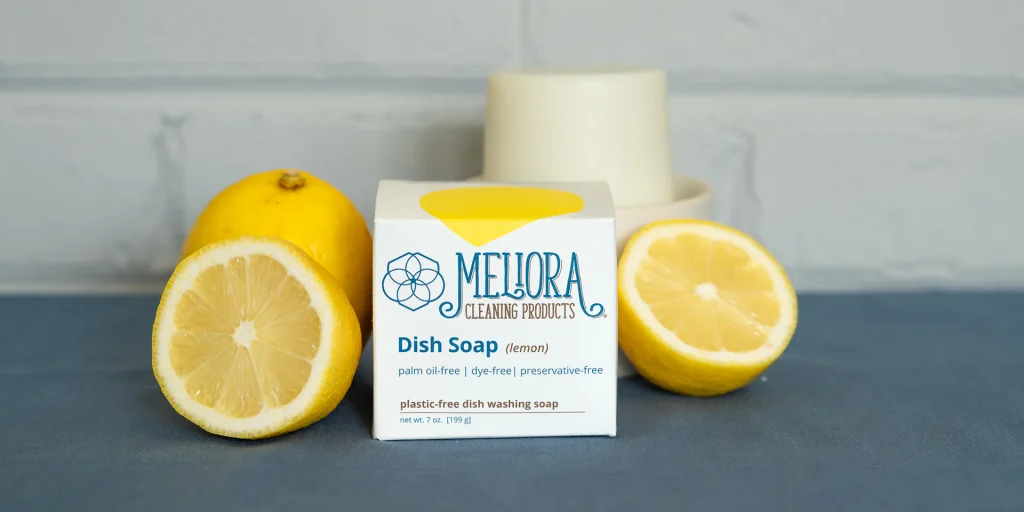
Meliora Dish Soap Bar
Meliora is another brand that I’ve come across that’s doing great things in the world of sustainability and low-waste cleaning products. Their dish soap is actually a solid bar that you place on the counter by your sink and rub a wet sponge on to create a lather.
It comes in recyclable paper packaging, but you can opt for a 100% zero-waste version which ships completely package free.



Hi, I used this recipe but the soap was so thick and stick together, no matter how much extra water I add to it. What did I do wrong?
You might need to adjust the amount of washing soda you use.
In regard to cost vs. store bought, you never know what you are getting with store bought. First of all, the large manufacturer’s source out many supplied form China with no idea that the supplies may be contaminated. Also, the law allows you to say your product is “All Natural” even if it is not. Manufacturer’s can call a product all natural and list proprietary artificial ingredients simply as “fragrance.” They don’t have to list artificial preservatives at all and can still call their product all natural. The worst form of mis-information is when they list 99% natural. Since most soaps and especially creams are 99% water, this is an easy claim even if all other ingredients are not natural.
Here is a an email I received from the president of a very popular product that is sold as all natural and who claims to be transparent about his ingredients: “There is no law that you must disclose all ingredients in the USA. The unfortunate fact is that usually tiny %’s of chemical preservatives must be put in a product so it will last longer than a few days once opened.”
My formula for dish soap is the same as listed here, except I add a drop of Wild Oil of Oregano as a natural preservative and antifungal. My only problem with homemade dish soap is that it is so damn thin and watery.
How much soap does this make?
Just about 1 1/4 cups
Hi! I’m researching for our local food pantry and social services organization about home made cleaners, especially those that can be made on a budget, or almost entirely with food stamps. I made the washing soda from baking soda following instructions I found on another site, and it worked really well for me. Since I am trying to get these things to work on a budget, I am a bit limited to the products I can use. I found some natural soap at a local dollar store ,packaged at 3 for $1, and used that in this recipe, along with the “homemade” washing soda and fresh lemon juice and pure lemon extract from the baking aisle. I am making mine in a big batch (using a whole bar of soap) because I want to give samples of it to the people I am reporting to. I am in the process of letting it set and then will try it out. So far, it looks like I am going to be able to make a bottle of dish soap that actually works for around 9 cents cash, and less than 75 cents of food stamp products. I am eager to show our community that this is a viable option!
Hey Stephanie, this sounds so awesome! I’m very curious to know how the dish soap turned out, using the dollar store soap. Also, homemade cleaners is totally my thing! So I invite you to check out the posts in our cleaning category here: http://naturesnurture.co/category/household-cleaning/ and let us know if you need help with anything. Best of luck to you!
Hey Sarah – do you need to use bar soap as well, or can you do it only with liquid? If yes, how much extra liquid castile soap should I use? – Marie
dear Sarah,
I just wanted to say THANKS for sharing such a wonderful DIY recipe. I used to feel the same as you, when diluting liquid castile soap which was… just ok. I settled for that for a long time because I knew that this was still a better option than using the chemical-laden alternatives. My major complaint was the film that was left on the dishes and on my counters.
I followed your recipe to a T.
But I looked in amazement when I saw that the dishes had no more film or greasy residue on them, nor my granite counters… SUCCESS !! I’m totally hooked : D
I wanted to share this with you and your followers. I’m very grateful for your post. Thank you for sharing the good stuff : ) I look forward to learning more from you and your natural lifestyle ; ) Bless.
Rosy
Thanks for the feedback, Rosy! Blessings to you as well. 🙂
Hi,
Thanks for this recipe. Quick question: Why is there a need to use both castile bar soap and castile liquid soap? Aren’t they the same just that one in liquid form another in solid form?
Hi Jordan,
Here’s a good post about the differences between the 2: http://www.lisabronner.com/liquid-vs-bar-in-dr-bronners-pure-castile-soap/
I just made this soap and couldn’t wait till it cooled!! So I washed my dishes and I love t!!!! Now we will wait and see how well the kids like using it 🙂 Reading all the comments of so many different recipes including this one is what helped me choose which one to try. Thank you so much for the time you took to make this available for us to try.
That’s great, Tanya, I’m so glad it’s working well for you! Thanks so much for coming back and letting us know 🙂
Hi! Love this!
I was wondering about the acidity of essential oils, like, would it interfere with the castile soap if I used grapefruit essential oil, or lemon? Or are they not acidic?
I’ve used orange essential oil without a problem.
Lemon oil is ph neutral and I suspect the same for that others. It’s the juice that’s acidic
I love the DIY recipes but it is kinda odd when someone recommends buying stuffs on AMAZON…
Any time you add water to a homemade recipe you need to add a preservative to keep bacteria from growing.
Even if you use distilled water?
ESPECIALLY if you use distilled water, because it’s not chlorinated. However, I doubt the recipes discussed in this thread will need preservatives, because people mention having to stir it to keep it from jelling hard. That implies that its water activity is low enough that it’ll probably self-preserve. I mean, not that it can’t spoil — jelly in a jar can still get moldy — but it seems like you people aren’t keeping it around long enough to do so anyway.
And thanks for sharing your recipe edits, Heather! 🙂
My soap is like water. My family and myself do not like. How warm should kitchen be?, where I live it’s hot! even with air! Thanks
I just noticed people have a problem with it turning into jello…..cute idea use little silicone molds and make little jelly soap packs!!!
That actually is pretty cute!
I used a recipe similar to this one I used borax and ivory. I hate it, everything is greasy. The ivory separates in the water floats to the top and leaves scum flakes all over everything. I hate having to start over. I may just go get a big bottle of dawn. It is my favorite and it is natural as well I believe. They use it to clean oil off of animals when there is an oil spill so it must be ok. Also they pour it in the water around oil spills to clean them up. Suppodildly!
You’d think that the ingredients used in baby products would be super healthy too, but think again! That’s mostly the whole idea behind making products ourselves. We can’t trust the manufacturers to keep us healthy and safe, we need to make sure of that ourselves. That’s why it’s a good idea to always check the ingredients of the products we use. If we don’t know what one or all of them are or what they mean, it’s time to start researching them.
Some people make their own products because they or their faimily can’t use the chemical laden ones. Others decide that they’d rather not expose themselves or their family to those chemicals after learning the facts.
Everyone is on their own journey for different reasons. Whatever the reasons, it’s nice to have others to help us out along the way. It’s best to remember also, that Rome wasn’t built in a day. Taking baby steps in this process is a sanity saver for sure, have patience with ourselves as well as others, and have fun along the way!
I swear by this recipe. Not only does it work but my family is much healthier since i started using it. Thank you!
That’s great, Holly! And thanks for the extra tips 🙂
Tried this recipe. Did not work. Residue and spots noted on my glassware and stainless steel sink. Would like to find something that is at least close to the commercial brands.Any suggestions?
I’m so sorry it didn’t work for you, Kat. The recipe seems to be very dependent on your water type, as castile soap doesn’t do very well with hard water. Think that may be the case?
Hi there, this recipe worked well for cleaning but seemed to thicken up like the consistency of egg drop soup. I used my immersion blender for about thirty seconds and it seemed to solve the problem. Consistent, a little foamier, and much more scent!! Thanks!
Awesome tip, Sue – thanks! 🙂
Think its important to understand that there is a difference between “soap” and detergent.
Detergents came into daily life after WWII. And liquid detergents for dishwashing not long after.
Before the war, powdered bar soap, and soap flakes were used for dishwashing, and laundry.They were Eco friendly and didn’t know it!
However, and this is a big however, they were commercially made soaps, and specifically made for dishwashing, and laundry. Not to take a bath with.
Bath soap normally has extra fat added, or unreacted oil contained therein to be conditioning to skin.
To be effective for dish, or laundry use, the soap has to be made without extra oil! After all that’s what we are trying to get rid of when doing dishes, or laundry!
Dr Bs and Kirks have this extra oil. So dose Ivory. This is why so many are having trouble with a greasy feel on the dishes, no suds, ect.
If you can find a “pure” soap thats made for the specific purpose of household cleaning, not to take a bath with, you’ll immediately see the difference.
Look for a soap that has what sometimes is refured to as having a 0% super fat! (No extra oil) This is what was used before detergents came along.
Try searching for “Lye Soap for laundry”
And don’t add vinigar. When using soap, for the reasons mentioned above by Samual, it deactivates the soap.
Actually “detergent” just means “cleaner”, without reference to its chemical makeup. So if you’re using soap to clean with, it’s technically a detergent too.
The distinction between laundry and bath soaps was never as great as you think. Ivory soap was sold for both purposes; the twin cake’s slogan was “one for kitchen, one for bath”, and you’d break the 7-oz. bar into 2 cakes, so obviously the same composition was in both; it’s not superfatted. Most other toilet soaps aren’t superfatted either, or are superfatted so lightly that you can easily still use them for laundry & dishwashing. However, there’s a distinction between “soap powder” and “powdered soap”, in that soap powder commonly included a small amount of alkali, such as the washing soda discussed in this thread — although the right kind of sodium silicate was better in combination with soap. “Powdered soap” is just that. However, Boraxo powdered hand soap actually contains more borax than it does soap. The cheaper soap powders contained more of the alkali; the ones for delicate fabrics, such as Ivory or Lux, had no added alkali.
The recipes that’ve been going around on the nets in recent years for homemade laundry detergent universally call for far too much in the way of alkali (washing soda and/or borax) to make a quality product. That’s why they’re so cheap-seeming. If they called for as much soap per use as a good formula would, they’d cost about as much as store-bought detergents, and they’d be too sudsy for HE machines. The only reason people aren’t seeing rapid fabric wear when washing with these home recipes is that many of them call for using so little per load that effectively they’re doing nothing but deodorizing the fabrics by neutralizing stinky acids.
Unfortunately Seventh Generation has palm oil in it as well. They label it sustainable, but from all my research there really is no such thing. Pre- existing palm oil farms are only good for 50 years. In general when looking for the ingredients on making soap, don’t buy anything that has cetyl alcohol, any kind of stearate, or sodium lauryl sulphate in it, its another name for palm oil.. Vegetable oil is suspect as well. It’a a generic name. Anything containing palm as part of the word is a no go. You try to go natural,organic, non GMO, then run into this problem. All my research so far on soaps, dishwashing etc, only lists Australian products with no online US shipping. If anyone knows something please let me know.
I’m reading this blog a bit late but I came across it looking for dishwashing liquid without palm oil ingredients. I’ve had exactly the same results like you did, Aida. Great products out there – if one happens to live in Australia. Seventh Generation uses RSDO-certified palm oil which means not much, it’s a promise on paper, still destroys forests and wildlife. Dr. Bronner uses true sustainable palm oil from small farms in Africa, as does Alaffia products. But both don’t make dish soap.
The one company I haven’t researched yet is Begley’s Best from Ed Begley.
Dr Bronner Castile soap has palm oil in it for foaming lathering.That’s probably why it works so well It’s contributing to destroying the rain forests through the ever increasing slash and burn palm oil plantations in Indonesia and South America. Orangutans are going extinct at a alarming rate. The Rain Forests are also lungs for the planet.
https://www.drbronner.com/ingredients/fair-trade-around-the-world/palm-oil/
You should read how they obtain their palm oil, it is not through slash and burn methods. Dr. Bronner’s is one of the few companies I trust.
Thanks for the cost breakdown, Hannah!
Hi Jean….
I chuckled every time your response came up! Well, you got MY attention and I have just two questions…first, where can I find a coconut laundry bar and secondly, will you share your ‘homemade lard’ recipe with me…never made it and have no clue what’s in it!!! But I am so willing to try it!!!
Thanks Jean!
try using grated homemade coconut and lard laundry bar….works perfectly
Would using distiller water resolve the problem with hard or soft water?
I’m not sure but it wouldn’t hurt to try. I’ve heard that using distilled water helps create more bubbles – not that bubbles mean clean, but you know… 🙂
Can you use fels-naptha bar soap for this recipe? Thanks!
I’m not entirely sure, but if you try it let me know how it goes!
I have the too thick problem, I add water and it is still too thick, what did do wrong?
Try reducing the washing soda? Or maybe increasing the liquid soap a bit?
So…do you have a recipe for dish soap that starts out with potassium hydroxide>?
Yes ! I’d also like a recipe for dish soap using Potassium Hydroxide. I’ve been making liquid soap for awhile now, but none of my recipes have worked for washing dishes : p
Do you have an estimated shelf life for this recipe? I was considering making it in bulk since that’s what I do with laundry soap, cleaner, etc, but I want to make sure it will keep well first. No sense in wasting!
Not sure about shelf life, but I know if it sits for too long, it’ll just turn into a solid block, which is why it needs to be shaken everyday. I wouldn’t make it in bulk for that reason. I’m still working on perfecting it, so I’ll keep the idea of bulk batches in mind as I continue to experiment!
So new to the green living thing, still getting my ducks in a row, but from all I’ve read about essential oils, you shouldn’t put them in plastic, because they degrade it and make it fall apart. Does this happen with this recipe, or is it just all diluted like and doesn’t matter? Just made my first batch of this and was pouring into my plastic bottle and was like “Wait a minute….” Loving the site so far =D
Thanks! If I’m using such a small amount in such a high dilution like this, I don’t really worry about it and I’ve never had any issues. However, some folks like to make sure to always use glass no matter what, so it’s really up to you.
For those looking for more suds…castille soap doesn’t provide lots of bubbles. You need coconut soap. Not sure about brands as I make my own, but coconut is where it’s at for suds! 🙂
Can i use lux soap flakes instead of castle?
I’m not sure what lux flakes are, but if it’s just a regular soap it should be fine. Either way, I’d try it out and see. 🙂
yes they do work, but not enough bubbles, might try castle soap next time, just to see if there is a difference, many thanks Sarah 🙂
I am a massage therapist and i’m looking for a hand soap that’ll take the oil off of my hands in between massages. Would this work as a hand soap by chance?
Hi Colleen, I wouldn’t use this as a hand soap because of the washing soda. But for hand soap, I use this recipe to make a foaming antibacterial hand soap 🙂
http://naturesnurture.co/2013/03/21/homemade-foaming-hand-soap-moisturizing-anti-bacterial/
For those of you getting oily-ish streaks using the homemade dishwashing soap – it could be your water. If you have a city supply, the amount and kind of chemicals in it bounces up and down as the water authorities add stuff to kill germs, remove colors and odors, etc. And I have heard that adding vinegar (acid) to your hoemmade mix will neutralize the soap (alkaline) so don’t do that.
a sure thing for grease….1 heaping tbsp of grated lard and coconut homemade laundry bar soap….jean
Hi there! This looks awesome, though is there a way to use all liquid soap?
I quartered the batch because I wanted to make a bit to see for myself if it worked and it doesn’t bubble or foam or anything. Any suggestions?
Hmm, a quarter of the batch seems a bit small I think. What is that, like a tablespoon of each of the soaps? I’m not sure, but it just seems a bit small to be able to properly test. I’m sorry I don’t have any suggestions, because I’ve never had a batch that didn’t bubble or foam. So I’m thinking it may be that the amount of soap in the quarter batch is just not enough to work properly.
I made the whole recipe. It bubbled while I was filling the sink, but the suds went away immediately. We do have hard water here, but I was really hoping for suds.
a sure thing for cutting grease and a sink full of bubbles…1 heaping tbsp of grated homemade lard and coconut laundry bar soap.
A quarter of the recipe, a third, a half, whatever, it SHOULD work regardless when you only use a very small amount when washing dishes. Perhaps this recipe just doesn’t work like you claim it does because I did a full recipe, following it exactly, and guess what? It didn’t work! Any suds, die instantly and I’m left with a sink full of cloudy water. Very disappointing given your assurances that you’d finally found a recipe that worked.
I’m sorry it didn’t work for you, Jodie. Although, if I understand your comment correctly, it seems like you are trying to use this recipe with a sink full of water to wash the dishes? Please correct me if I’m wrong, but if that’s the case, I’ve already addressed this issue at the end of my post, and tried to make it clear that this recipe probably wouldn’t work very well if you wash your dishes using the soaking method. I just apply the detergent to a wet sponge and scrub the dishes that way – with that method, the dish soap works almost perfectly.
I hope that helps to clarify 🙂
Suds do not imply its cleaning, or not cleaning….Suds are not a sign you have made usable soap….Its all about the chemistry of your soap and dishwater…….Again, suds or lack of dont mean its working or not working….My laundry and dish soap do not suds up but wash very well….
Maybe try adding vinegar to your rinse water… but NOT with your soapy water as it unsaponifies the oil in the soap. I personally don’t do this but I’ve heard vinegar makes an excellent rinsing agent.
So isn’t washing soda toxic? And a skin irritant? I used baking soda instead and it worked great 🙂
Washing soda is caustic and should be handled with caution, as per the instructions on the box. It can be skin irritant if handled directly, which is why it’s a good idea to wear gloves if handling it directly. However, personally I think the 1 tablespoon in this recipe is so diluted with water and soap that it shouldn’t cause any significant irritation for someone with normal skin. That being said, I always wear dish gloves when washing dishes because I have eczema on my fingers, which just gets aggravated by constant contact with water…
But I’m glad you went ahead and tried the baking soda and let us know that it worked well! Thanks! 🙂
I added the zest of a lemon and some dried mint to the boil and it worked out great. And if you use Kirk’s Castile, it’s about a third the cost of Dr. B’s.
Really? Weird, because that’s the same experience that I usually have with the other recipes that I’ve tried, but this recipe worked perfectly for me. How much washing soda did you use? Do you have hard water, by any chance? Washing soda acts a degreaser and water softener, so you may want to play around with the amount you use in the recipe. Let me know what you end up doing and how it goes! 🙂
Is it possible if you’re not using washing soda it could be due to that? washing soda is a degreaser and you’re not using it you’re not degreasing.
I’ve found if i’m washing really oily surfaces, ex. coconut oil residue, it works best if i put a new squirt and work with that. and sometimes i have to double wash oily containers. other that that, i love the dish soap. no difference from 7th generation free & clear.
and i have super super soft eggy water so i always have some spots on my dishes. no big. i’m just grateful i have a kitchen and dishes to eat off of, and soap to wash with. and more than one pot.
One last thing- instead of using essential oil, i used a dr. bronner’s peppermint soap bar because it’s all target had. It has a lovely smell when i’m washing!
Peppermint is my scent of choice as well! 🙂
And yes, washing soda works as a degreaser, so it’s definitely important for this recipe. Thanks for the tips on working with oily surfaces – that’s what I do too 🙂
Hi Sara,
sorry for the late reply, was on vacation.
I followed the recipe using the washing soda as directed. Then i tried another batch, with less and then more washing soda. also did a batch with a little bit of borax.
I think i do have hard water. with the batches i’ve made, the top gets hard, so i have to shake the bottle till everything is mixed….and its still oily.
i think its the water. 🙁
someone told me to try to put salt in the mix as well, as salt helps soften water. so i’ll try that next. 🙂
thank you!
btw…love this site!!! 🙂
No, common salt won’t soften water. It will recharge a water softening unit, but it doesn’t work directly on the water.
i just made some, it’s cooling right now! hopefully i’ll like this as much as 7th generation free & clear, which i’ve been using for years.
to address the question of how much bar soap, i used dr. bronners peppermint bar soap, a 5 oz bar. i cut off about 1/4 of the bar to grate, but needed less than that. i put the extra grating and pieces back to use another time, and i spilled some gratings too, but overall i would estimate i used 1/5 of the bar for this recipe. probably even less. i hope this helps!
Thanks Terry!
How much of the dr. bronners bar soap is 1/4 cup grated? half of the bar? one quarter?
I grate a lot of soap at once in my food processor and just measure it from there, so I’m not really sure how much if the bar it is. It can’t be more than 1/4 of the bar though. I really need to measure it properly so I can do a price breakdown though!
I used Ivory bar soap, and if you put it in the microwave for a little bit, it “grows” and becomes this fluffy cloud that crumbles easily into powder. I just put what I didn’t use for this recipe into a container to use when I need it for the next batch of dish soap. (If you put it in the microwave, put it in something a LOT bigger than you think you’ll need. It really grows!)
1 bar of castile soap grated fills a 10oz cup, about 144g
I just made the soap (haven’t tried it yet). It took about 1/4 bar to create 1/4 cup.
I made this following the exact recipe. It works very well. It does not have a lot of suds but they are not necessary. I used Dr. B’s lavender soap (liquid and bar). Added some essential oil of lemon. I did not have the issue with it being too thick, I found the opposite and plan on adding more washing soda next time. Sarah I love your website and rely on it all the time. I have only recently switched over to the ‘natural’ side and I am loving it…again thanks to you and your website.
Glad it worked for you, Cindy! And thanks for the kind words. 🙂
I made dish soap before in a few different ways. However, I kept running into problems. Therefore, I almost thought I would never get to have homemade dish soap. Then one day I was really brainstorming about it and God said, “Why do you need to grate the soap and add anything?” It was an Epiphany. I took the natural coconut bar soap which is like a $1.??; put it in a dish, got my wet sponge,lathered it up and did some dishes. Wow! They were squeaky clean and it did everything I needed it to do. 1. Not have ingredients in the soap that I can’t pronounce and some article tells me it’s dangerous to the health of humans 2. Wash dishes squeaky clean. 3. not cost an arm and a leg. Now all I have left to perfect this experience is make my own coconut soap and I’m all homemade. The soap I buy is Kirk’s bar soap which is at walmart, and some grocery stores. However, it’s not at every Walmart. Although, I have found it at some grocery stores and other stores it’s simply either going to the store and seeing if they have it, cold calling the store and asking if they have it, researching their website ; where there is a will there is a way! I had to share!
Okay this is strange apparently sometimes I feel this oily feeling on the dishes and my hands whenever I clean with “Kirk’s castile soap,” however at time I feel squeakiness. Therefore, I’m going to experiment with different bars of soap. I am still holding true to the simple bar of soap for dishes:)
this sounds great. love that you heard from God for this idea. i just bought a few bars of kirk’s natural soap for the first time and have one sitting at my kitchen sink. i’m going to try using that bar of soap on the dishes too since i’ve just run out of dishwashing liquid. thanks!
I have been looking for awhile to making my homemade liquid dish soap for awhile and I am not even going lie that same epiphany popped up in my mind as well. So I am going with it. I know a lady who make home made natural soap https://www.facebook.com/naturalbodytreatsLI , but I want to learn to make my own soap as well. Will report my experience later. Thank You & God Bless You.
Hi Sarah, I made a recipe of this dish soap and followed the recipe exactly with the exception of using Zote grated soap (unable to get castile) and adding about one tbsp of liquid glycerin. This soap is amazing and leaves the dishes “squeaky clean”, literally!! Love, love, love, …….. The only issue that I have is that it thickens up quite a bit, a little firmer than set jello, and I keep adding water and it is still thick. I noticed that when I added the washing soda to the water/ grated soap mixture, that it started thickening up at that point. I am wondering if I keep adding water, will that not weaken the soap recipe? Do you know if the washing soda is used strictly as a thickener? Can I use Borax instead of washing soda? Any ideas how I can ” liquify” without compromising the recipe? Regards, Dianne
Hey Dianne,
Yeah, I have the same thickening issue as well, and I just a tiny bit of warm water to it, shake it up real well, and it’s good to go. I do this quite often since my kitchen stays pretty cool and it hasn’t compromised the strength of the soap at all. You could try decreasing the washing soda (not sure about eliminating it, but if all else fails, I’d try that as well). I’ve seen some recipes use borax instead of washing soda, although I haven’t tried it. Like with most homemade cleaners, it’s all about experimentation, and I’d love to hear what you come up with that works for you.
I used Zote with washing soda and borax for laundry soap as I like the smell of it better than fels naptha, but it continues to thicken. It only takes 1 tbsp per load of clothes, so I add lots of hot water to it, it melts right away and is. Great for laundry. No suds however. Castile liquid is not used in laundry soap and doesn’t suds, but cleans really good! Tatally rinses out! I can’t see that this will suds for dishes but will try it tomorrow!
Glycerin is a thickening agent. It make give you a luxurious lather, but also thickens.
It’s the bar soap that causes it to thicken and become jello-like. I’d omit it and use only liquid soap. It will make it runny so just add more washing soda to thicken. Just a suggestion
Would glycerin bar soap be an acceptable substitute for the castile bar soap?
I would totally try it and see if it works. I’ve seen people use homemade soaps and even regular store bought soaps like Ivory. So if all you have is glycerin soap, I’d give it a shot. Maybe make a smaller batch to test it out? I’d love to hear how it goes. Good luck!
Sarah, I have a question.
I’ve been trying to create a project involving edible soap, and this was the first site I went too to make the soap liquid (before this I made edible hand soap and figured out an edible alternative to washing soda). So, with the liquid castile soap, do you know an (edible) alternative?
I’m so sorry, Olivia, but I have no idea! I’ve never come across this before. I’d love to hear more about your other edible alternatives! 🙂
I’d be very interested to know what’s in your edible hand soap. I tried consulting with someone a few years ago to make edible “soap” (any kind of soaplike detergent). I knew actual soap soap wouldn’t work, so I tried the most digestion-friendly surfactant I could think of — sucrose laurate, related chemically to Olestra — but the result from swallowing 10 grams was diarrhea, as bad as or worse than a colonoscopy prep. (But the same is known to happen with Olestra if people eat too much of it.) And sucrose laurate cleaned only about half as well as Ivory soap on lampblack-stained cloth. AFAIK any surface-active agent you might swallow in amounts sufficient to clean with will do this — certainly actual soap will. Even bile salts — which enter your digestive tract from your gall, and can be used as detergent — will do this if you swallow them in significant amounts. So what are you using and how much at a time can someone actually eat of it without diarrhea?
I made this but I read that washing soda is very alkaline and can burn the skin when I was trying to figure out if I could use washing soda to thinking body soap I made is this true. I would be a hassle to wear gloves every time to do dishes.
Yes…washing soda is harsh on your hands…therefor I can’t use it.
Why do you use both liquid and bar and not just one or the other?
Susan, to be honest, I just followed the recipe exactly because my main goal was to find a recipe that works. I’ve tried so many over the past year, that I really wanted to follow a recipe to a T. But now that you mention it, it may be worth experimenting with to see if using just one or the other would work. 🙂
Curious how using just one over the other worked out?
Hi Sara, thanks for the wonderful recipe.F inally found one that actually works.
I’ve followed your recipe. It’s great, but it’s a little too slippery. Which ingredients should i reduce?
I’m curious how using just one over the other worked out.
If it’s too slippery, try reducing the washing soda a bit and see how that works. Glad you like the recipe!
Thanks for reporting back, Marilyn!
Actually, hemp is anti-estrogenic.
How is this at cutting through grease? I’ve made homemade dish soap before and it was a bust. I really want to try this one if it works!
Lori, it’s awesome! I know because I’ve also tried several recipes that just didn’t get the job done. This soap works just like regular store bought soap, even my mom is comfortable using it (which is saying a lot since it usually take a little longer for her to jump on the homemade train lol).
I have used this recipe and a few others as well as using straight Castile soap. Still have greasy dishes and spotted greasy silverware. I really would like a recipe that works but cannot find one.
If the castile bar soap and liquid castile soap , dr b’s, is expensive (which it is)…how is this saving money? I can get Bon Ami Natural dish soap for $3. for 25 oz. I love making homemade, but this is a lot for a little amount. What is the advantage here?
well, the initial investment isn’t just for one batch of soap. you can get at least 5 batches from the dr. bronner’s bar soap, and you can use the liquid soap for other household things. (i used dr. bronners tea tree and hemp soap when my cats had fleas- i deposited the fleas in the soap and hot water mixture and it fdid them in right away.) and you can also use kirk’s coconut castile soap, which is much cheaper than dr. bronner’s. you may also be able to find dr. bronners online cheaper than in the store.
for me, the advantage is knowing exactly what is in my soap. dr. bronners is an honest, trusted, natural company. i don’t trust big name brands that put out ‘natural’ products: the definition of natural is wide ranging and still contains chemicals. it’s worth the money and time investment to know exactly what’s in the products i use, plus it’s really fun to make stuff like this!
Thumbs up , Terry! I love your response
Thanks for these awesome ideas. FYI, I bought an 32oz bronners peppermint liquid soap at Trader Joes for only $9.99. Great deal
Hi Jeanne,
I love bon ami powder. It is a safe affordable cleanser, but according to EWG (Environmental Working Group), Bon Ami dish soap is very dangerous to the environment and the skin. Just thought you should know.
Actually, this soap recipe would be more natural than what you’re buying from Bon Ami.. because there’s actually ingredients in that supposed natural product that can cause allergic reactions and nerve damage!
http://www.annmariegianni.com/ingredient-watch-list-methylisothiazolinone-the-toxic-ingredient-that-could-cause-nerve-damage/
I actually cannot use products containing this or the other Methyl- chemical, because it makes my skin itch like crazy! Soooo, I would say it would be worth the investment!
Just in my opinion!
BTW Thanks for the recipe!!
I know this is an older post, but as of Summer, 2014, Bon Ami has DISCONTINUED ALL OF ITS DOMESTIC LIQUID SOAPS. Only the Free & Clear Baby Liquid Soap is available, but only OVERSEAS. It doesn’t have a SKU for the United States. Also, the company is completely out of stock so if you know of some place that still has stock, GRAB IT UP. Below is the official letter from the company, received 9/21/2015, which is why I am surfing the net to find a natural recipe. Thanks for the dish soap recipe, I will try it out!!! Back to the message from the company below:
Thank you for your email expressing interest in the Bon Ami® cleaning products. We always appreciate consumer inquiries.
All of our [domestic] liquid Bon Ami® cleaning products, including the Dish Soap, have been discontinued. These items were retired Summer 2014. The brand does enjoy a loyal following, but there simply wasn’t enough retailer or consumer interest in the liquids. In-store inventories are likely sold out, and we have no remaining inventory.
We do continue to offer both of the powdered Bon Ami products. These may be purchased in-store or from our catalog affiliate @ http://www.agelong.com [1-800-892-8022]. If you are a Facebook user, you might consider adding Bon Ami to your “likes” on http://www.facebook.com/bonamiclean and you will receive info on your Facebook status feeds when we run new products, contests, or promotions.
The Bon Ami® Baby Soap is exported to select overseas markets only. We do not offer this item to domestic [USA] accounts, and this SKU is not available for mail-order. We do apologize for any frustration or inconvenience.
Again, thank you for taking the time to write. We sincerely appreciate your previous patronage. If you have future questions or product feedback, we are always happy to help.
-Renee –
Consumer Specialist
Bon Ami Company